
Off-grid site security, Kent WA and the South Sound
Anywhere worth stealing from,
with nothing to plug into.
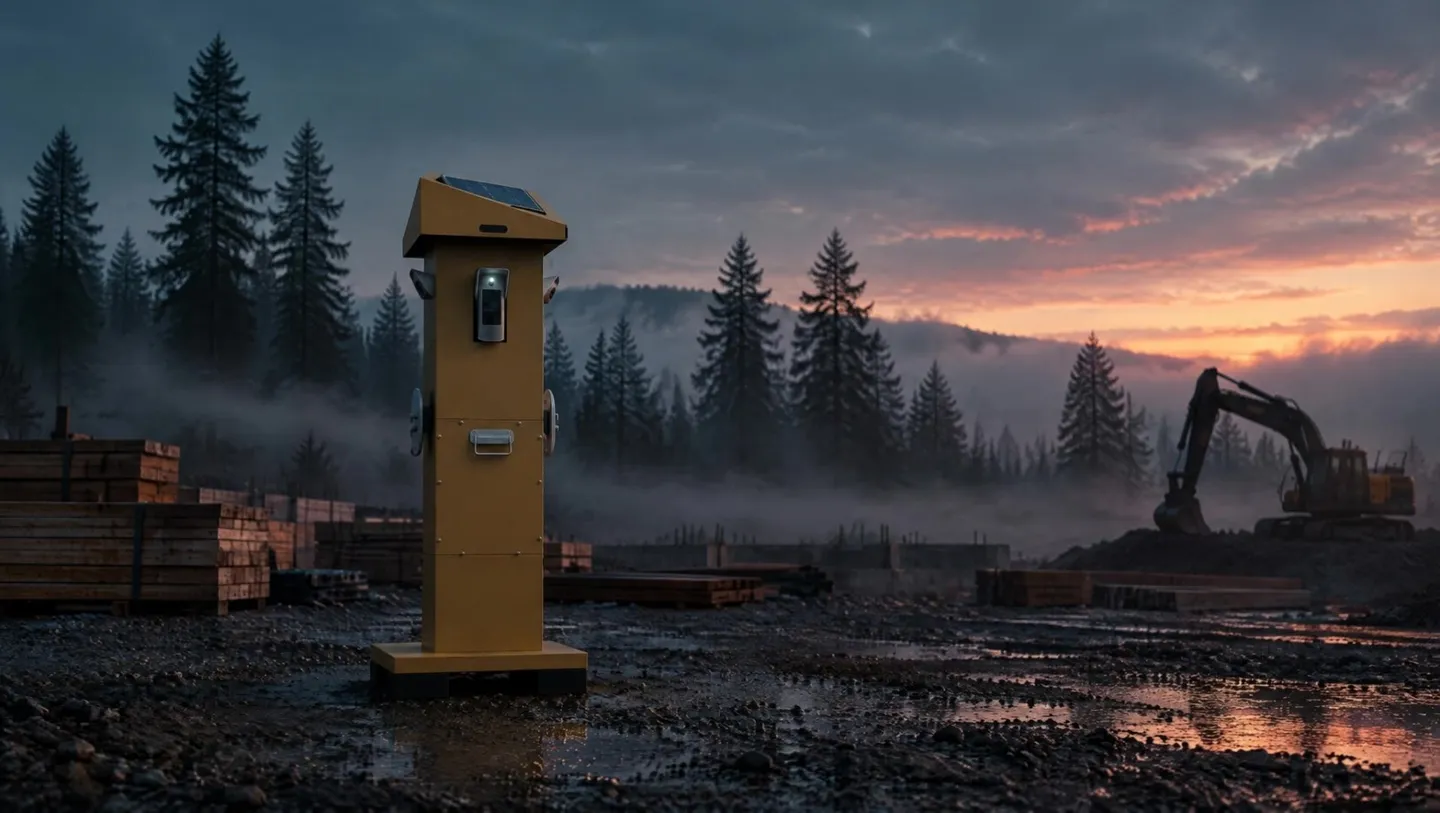
A construction site is the obvious use. It is not the only one. Anywhere that holds value, sits unattended and has no power to wire to is the same problem: a parking lot, a storage yard, a marina, a vacant building between tenants, a lot that only opens in December. Here is where a solar alarm tower earns its keep, and where it does not.


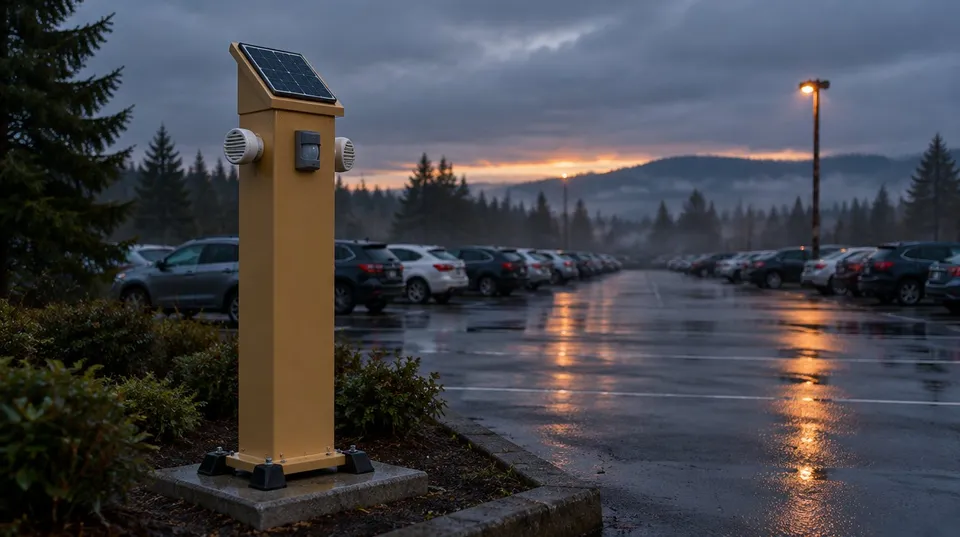
A solar alarm tower suits any site that is unattended, holds something worth taking and has no mains power or internet. Common uses are surface and overflow parking, fleet and dealership lots, self-storage and RV or boat storage, marinas, equipment and materials yards, vacant commercial property between tenants, farm outbuildings and irrigation equipment, and seasonal or temporary retail. It detects intrusion, photographs what triggered the alarm and sounds sirens, reporting over its own cellular connection. It does not record video, so it is the detection layer and sits alongside a video system rather than replacing one.
- The test
- Unattended, holds value, nothing to plug into. If all three are true, this fits
- Deploys in
- An afternoon. No trenching, no conduit, no electrician, no network
- Coverage
- Detectors can sit on fence posts, poles and container walls in radio range of the tower, not only on it
- Seasonal use
- Goes up for a season and comes down after. A tree lot, an event, a summer closure
- Not a camera
- Photo verification, not video. It is the detection layer and works with a video system, not instead of one
- Where the evidence is strong
- Cannabis premises have explicit Washington alarm rules; vehicle lots have documented converter-theft exposure
- Where it is judgement
- Storage, marinas and vacant property are sound use cases without published Washington theft counts
- Response
- Call or text back within one business day
The test is three questions
Is it unattended for long stretches. Does it hold something worth taking. Is there nothing to plug into.
If all three are true, a solar alarm tower fits, and the site type barely matters. A construction site is the obvious case because it is all three at once for eighteen months. Plenty of other ground is all three every night.
Parking, fleet and dealership lots
A surface lot has power at the building and nothing where the cars are. The risk is at the far end, under the one light that stopped working in March.
What you want to know is not what a lot looked like yesterday. It is that somebody is moving between parked vehicles right now. A detector covering the rows and the approach answers that, the sirens sound where the person is standing, and the photo tells whoever gets the alert whether it is a customer or a problem.
Washington legislated on this: HB 2153, effective April 2025, tightened records and identification for catalytic converter transactions to make trafficking harder1. Nationally the NICB counted 14,036 converter thefts in 2024, down 68 percent from 2023, so the peak has passed, but a converter still leaves a vehicle in a couple of minutes. Overflow lots, park-and-rides, trailheads and dealership back rows share the same shape: many stationary vehicles, low occupancy, poor sightlines.
Honest note: we found no published Washington dataset breaking theft down by lot type. The infrastructure case is solid. The statistics for your specific lot do not exist.
Storage yards, marinas and rental fleets
Self-storage rows, RV and boat storage, equipment rental yards, tow and impound lots, contractor yards. Long runs, poor lighting, assets that sit still for months, and usually no power where the back fence is.
A DualCurtain Outdoor detector suits these particularly well, because it watches a line rather than an area: 15 m each side, 30 m total, laid along a fence run or across an approach. One tower can hold the hub while detectors sit on posts down the length of the yard.
We could not find published Washington theft counts for these site types, and we are not going to invent one. The case here is operational: the infrastructure problem is real and the assets are immobile and valuable.
Vacant commercial property between tenants
The power is off, the last tenant's alarm contract went with them, and the building still holds copper, HVAC condensers and fixtures. This is a gap that lasts exactly as long as the vacancy and nobody wants to sign a monitoring contract for.
A self-contained tower covers the approach, the doors and the mechanical yard, with no account to open and no electrician to book. It leaves when the new tenant signs.
Licensed cannabis, where the rules require both layers
Washington is the clearest proof that intrusion and video are not alternatives. The regulator requires both, separately, and will not accept one in place of the other.
Licensed premises must carry a security alarm on all perimeter entry points and perimeter windows, and must separately run continuous video at a minimum frame rate with at least 45 days of retention on IP-capable equipment2. An outdoor grow needs an eight-foot sight-obscuring fence and camera coverage reaching 20 feet beyond the perimeter fencing and gates3.
So a compliant site runs a detection layer and a video layer together. A solar alarm tower can carry the detection side at a gate, along a fence line or at a remote corner where power does not reach, which is usually the part that is hardest to wire. It does not record video and therefore does not satisfy the surveillance rule on its own. Any vendor telling you an alarm covers your surveillance obligation is putting your licence at risk. We design the video side with it, or work alongside whoever already has. Where the two are bridged so an operator sees the clip the detector triggered, that is video verified monitoring.
Farms, outbuildings and irrigation
Pumps, pivots, fuel tanks, tool sheds and equipment parked at the far end of a field. Power reaches the house and the barn, not the eighty acres past them. A tower with detectors on fence posts covers a gate and an equipment line without trenching a mile of conduit.
Seasonal and temporary
The case nobody plans for. A Christmas tree lot, a pumpkin patch, a farm stand, a fireworks stand, an event lot, a school yard over summer break, a seasonal business closed from October.
Inventory is concentrated, the structure is temporary, there is no power and no network, and the season is too short to justify wiring anything. It goes up in an afternoon and comes down in another.
What we would tell you not to use it for
Anywhere you need recorded video. Anywhere a regulation names video specifically. Anywhere the actual requirement is a person at a gate rather than an alarm on a fence.
There is a version of this conversation where we sell you a tower for a site that needed a guard or a camera system, and we are both unhappy in six months. We would rather have the short conversation now.
Where we work
From 415 Railroad Ave S, Kent, WA 98032: Kent, Renton, Tukwila, Federal Way, Auburn, Covington, Maple Valley, Tacoma, Puyallup, Sumner, Bonney Lake, Tehaleh, University Place and Gig Harbor. The Olympic Peninsula and sites farther afield are by appointment and quote.
Where else does this work?
Can it cover a parking lot?
Yes, and it is one of the better fits, because a surface lot usually has no power where the risk is. Detectors watch the rows and the approach rather than the whole lot, since what you want to know is that somebody is moving between parked vehicles at 3 a.m. Washington passed HB 2153, effective April 2025, to make catalytic converter trafficking harder, which tells you the problem was real enough to legislate.
Does it work for self-storage, RV or boat storage?
It suits them well on the infrastructure side: long rows, poor lighting, no power at the far end, and assets that do not move on their own. We will be straight that we found no published Washington theft count for these specific site types. The case for them is operational rather than statistical, and we would rather say that than quote you a number we cannot source.
What about a licensed cannabis grow?
It carries one of the two layers Washington requires, and the rules are a good illustration that these work together rather than instead of each other. Licensed premises must carry a security alarm on all perimeter entry points, and must separately run continuous video with at least 45 days of retention on IP-capable equipment2. An outdoor grow also needs an eight-foot sight-obscuring fence and camera coverage reaching 20 feet beyond it3. A solar alarm tower can cover a gate, a fence line or a remote corner. It does not satisfy the video rule, and anyone telling you it does is risking your licence.
Vacant property between tenants?
A good fit, and a common one. The power is often shut off, the alarm contract lapsed with the last tenant, and the building holds copper, HVAC units and fixtures. A self-contained tower covers the approach and the doors without an account, a contract or an electrician, and it leaves when the new tenant arrives.
Can it go up for one season and come down?
That is one of the things it is best at. A tree lot in December, a farm stand in August, an event lot for a weekend, a school yard over summer break. Nothing is trenched and nothing is wired, so the install and the removal are both an afternoon.
What would you tell us NOT to use it for?
Anywhere you need recorded video, anywhere the regulation names video, and anywhere the real requirement is a person rather than an alarm. A site that needs somebody at the gate needs a guard, and we will say so. We would rather lose the sale than sell you the wrong thing and be back in six months.
Tell us about the site.
Where it is, what is on it, how long it sits empty and whether there is power. We will tell you whether this fits, and say so plainly if it does not. We call or text back within one business day.