

Business Wi-Fi and network installation, Kent WA and Tacoma
Business Wi-Fi
that holds on a Friday at noon.
Ruckus access points on an Access Networks platform, VLANs that keep guests away from point of sale, PoE switching sized for cameras and phones, cabling labeled at both ends. For offices, shops, clinics and restaurants across south King County and Pierce County.
Two business networks you can look at, and the cabling under them.


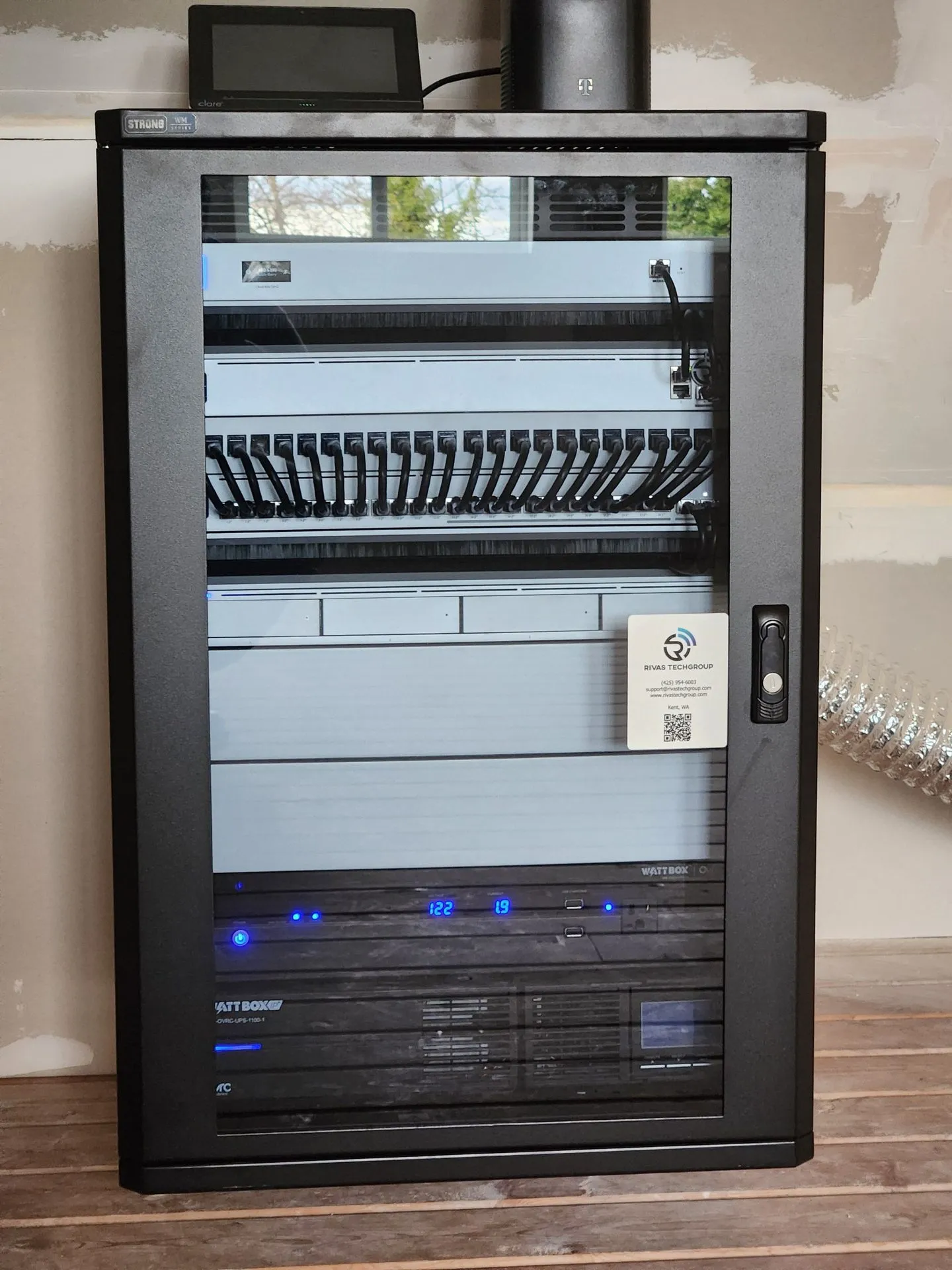
Rivas Technology Group installs business Wi-Fi and networks in Kent, Tacoma and the South Sound. Each job starts with a site survey and heat map. We install Ruckus Wi-Fi 6E or Wi-Fi 7 access points on a Ruckus-based Access Networks platform, VLANs for guest, point-of-sale, camera and staff traffic, and PoE switching. The CURATOR care plan manages it after install.
- Response
- Call or text back within one business day
- Access points
- Ruckus Wi-Fi 6E and Wi-Fi 7; Access Networks certified
- Segmentation
- Separate VLANs for guests, point of sale, cameras and staff
- Handoff
- Heat map, port map and passwords in writing
- Care
- CURATOR remote monitoring and support after install
- License
- WA electrical contractor RIVASGL799DR, bonded and insured
What does a business network include?
Seven parts, designed as one system: a survey and heat map, a router with a real firewall, wired Ruckus access points, VLANs, PoE switching, labeled cabling and remote management.
- Survey and heat map. We measure the space before ordering hardware, so access points land where the signal is needed.
- Routing and firewall. UniFi Enterprise routing on both projects linked here; an Island Router where a business wants subscription-free, US-built routing.
- Access points. Ruckus, each on its own cable and PoE port. No wireless hops between them.
- VLANs. Guest, point of sale, cameras, phones and staff on separate networks with rules between them.
- PoE switching. Sized to the cameras, phones and access points it must power, with headroom.
- Cabling and rack. Cat6 to desks and cameras, Cat6A to access points, fiber between rooms, every run labeled and tested through structured cabling.
- Management. Cloud management for the hardware, CURATOR for the people watching it.
Which access points do we install?
Ruckus, on the Access Networks platform, with Ubiquiti or Island where the job calls for it. Rivas Technology Group is Access Networks certified; Access Networks builds its managed Wi-Fi on Ruckus hardware and controllers1. Three Ruckus indoor models cover most South Sound businesses:
- R670, Wi-Fi 7. Tri-band, 6 spatial streams, 9.34 Gbps combined rate, a 5 GbE port, up to 768 clients2. The office and clinic workhorse.
- R770, Wi-Fi 7. Tri-band with 4x4 on 5 GHz, 12.22 Gbps combined rate, a 10 GbE port and 802.3bt PoE3. For a venue floor or a warehouse with hundreds of devices.
- R760, Wi-Fi 6E. Tri-band 4x4:4, 8.35 Gbps combined rate, up to 1,536 clients, where a Wi-Fi 6E fleet is already in place4.
Ruckus BeamFlex antennas and ChannelFly channel selection are on every model, and each one runs on RUCKUS One, SmartZone or Unleashed3. Ubiquiti UniFi is the alternative when a business wants routing, switching, Wi-Fi and cameras in one license-free console5. South Sound Law Group and Washington Pottery Company both run UniFi Enterprise routing. Alta Labs, EnGenius and Zyxel fill specific needs. We install and support all of them.
How do VLANs keep guests away from point of sale?
By giving each kind of traffic its own network and a firewall rule between them. A restaurant gets four: guests, point of sale, cameras and staff, with phones on a fifth where VoIP is in scope. The guest network has client isolation and one route, out to the internet. The PCI Security Standards Council requires a firewall between any wireless network and the cardholder data environment6.
It also says a guest network segmented that way can sit outside PCI scope. A VLAN tag alone is a label; the rule on the firewall is the control. We write the rules explicitly and test them from a guest device before handoff. Cameras on their own VLAN mean a video upload never slows a card terminal. Staff Wi-Fi uses per-device keys where the platform supports them, so a departure does not mean re-keying the building.
How are PoE switches sized?
By adding up what every port must power, then leaving headroom. A phone or a standard camera draws up to 15.4 W under 802.3af. A PTZ camera or a Wi-Fi 6 access point draws up to 30 W under 802.3at. A Wi-Fi 7 access point can draw 60 W or 90 W under 802.3bt7. A switch has a total budget, not just per-port ratings.
The Ruckus ICX 7150 line runs from a 62 W compact model to 1,480 W with two power supplies8. A 12-port switch with a 124 W budget cannot run twelve cameras and four Wi-Fi 7 access points, whatever the port count says. We count devices, size the budget at about 70 percent load, and put the switch on a UPS so a short outage does not drop the phones.
What cabling does Wi-Fi 6E or 7 need?
Cat6A to every access point, Cat6 to desks and cameras, fiber between rooms and buildings. Wi-Fi 7 access points ship with multi-gigabit uplinks: 10 GbE on the R770 and 5 GbE on the R6703. Cat6A carries 10 Gb the full 100 meters and handles the heat of 802.3bt power with more margin, so pulling it once beats pulling twice. The structured cabling page covers drops, racks, patch panels, fiber and the port map you get at handoff. All of it runs under WA electrical contractor license RIVASGL799DR.
How does a site survey and heat map work?
A predictive design on the floor plan first, then a walk with a meter to prove it. A Wi-Fi heat map is signal strength drawn over your floor plan, so coverage gaps show up in relation to walls and access point locations9. The design phase models wall materials, ceiling height and the exact access point model to place each unit before cabling is run10.
The site walk measures signal on both sides of walls, racks and coolers, and notes interference sources such as microwaves and a neighbor's network11. After install we walk it again and hand you the validated map. The survey also produces the Cat6A drop count and the PoE budget, which is where the proposal's numbers come from.
How does guest Wi-Fi with a captive portal work?
A guest joins an open network, sees your page, accepts the terms or enters a code, and gets internet and nothing else. RUCKUS One builds captive portal networks with several sign-on options, including host approval12. With host approval, a guest requests access and a named employee approves it by email for one hour to one month.
The portal carries your logo and terms. The network behind it is the isolated guest VLAN from the section above, with per-client rate limits so one download does not slow the room. A hotel, clinic or restaurant gets a schedule so guest Wi-Fi turns off after close.
Who manages the network after install?
The hardware's cloud console, and our team under CURATOR. RUCKUS One manages Ruckus access points and ICX switches from one cloud dashboard, and Ruckus Unleashed runs controller software on the access points themselves for smaller sites13. UniFi sites are managed through the license-free Site Manager5.
CURATOR puts people behind the dashboard: health monitoring, unlimited remote support in business hours, a quarterly check, remote updates, a named contact and a four-hour response. Washington Pottery Company runs under it, which is why an outage there is a ticket to us rather than a closed store. Installation workmanship is warranted for 90 days on every job (pricing and policies).
Which projects can you look at?
Two commercial networks, each with its own page. South Sound Law Group, Tacoma: a law firm had spent years with a provider whose fixes never stuck. We replaced the network with UniFi Enterprise routing and business Wi-Fi covering every office and conference room, documented the configuration, segmented client data and kept cloud remote support. The slowdowns ended.
Washington Pottery Company, Kent: point of sale, phones and order lookups ran on a network that kept dropping. We staged and labeled a UniFi Enterprise system before install day, put Wi-Fi across the facility and VoIP phones on the same network, and enrolled it in CURATOR. The network stays up and every call connects. Cameras for the same buildings are on security cameras.
What drives the cost?
Access point count, cable drops, switch size and PoE budget, whether a rack exists, and how the building is built. A three-room office with usable cable and a closet is a small job. A 20,000 square foot warehouse with new Cat6A, fiber to a second building, a rack and a 48-port PoE switch is a large one.
A permit, after-hours work and licensed trade partners come with it. Hard-lid ceilings, masonry and coolers raise labor; drop ceilings and existing conduit lower it. Ruckus hardware costs more than consumer gear and less than a year of dropped sales. A site survey produces a fixed proposal, and the instant estimate gives a first range in four questions.
Where do we work?
From 415 Railroad Ave S, Kent, WA 98032, about 25 to 30 minutes from downtown Tacoma, across south King County and Pierce County. Cities: Kent, Renton, Tukwila, Federal Way, Auburn, Covington and Maple Valley, Tacoma, Puyallup, Sumner, Bonney Lake, Tehaleh, University Place and Gig Harbor. Olympic Peninsula by appointment. Our own team designs every network; on commercial projects we bring in licensed trade partners under our design and supervision.
Rivas Group, LLC dba Rivas Technology Group holds WA electrical contractor license RIVASGL799DR, active, bonded and insured (L&I lookup). We are BBB accredited with an A+ rating (BBB profile) and rated 5.0 from 49 Google reviews. Home networks are on Wi-Fi and networking; the commercial hub lists every business service.
Questions business owners ask about Wi-Fi
How much does business Wi-Fi installation cost in Tacoma?
Access point count, cable drops, switch size and whether a rack exists set the price. A three-room office with existing cable is a small job; a 20,000 square foot warehouse with a new rack and fiber is a large one. The site survey produces a fixed proposal, and the instant estimate gives a first range.
How many access points does my office need?
Fewer than you think, placed where the survey says. A Ruckus R670 serves up to 768 concurrent clients2. Count is set by walls, ceiling height and how far a phone must be from an access point, not by headcount. The heat map answers it for your floor plan.
Do you use Ruckus or Ubiquiti?
Both, chosen by the job. Ruckus on the Access Networks platform, where our team holds its certification, for offices, clinics and venues that need dense, quiet Wi-Fi. Ubiquiti UniFi where a business wants one license-free console for routing, switching, Wi-Fi and cameras. Both projects on this page run UniFi Enterprise routing.
Can guests use the Wi-Fi without reaching the point of sale?
Yes, and that is the design rule. Guests get their own SSID on a VLAN with client isolation and one path, out to the internet. The PCI Security Standards Council requires network security controls between wireless networks and the cardholder data environment6. A captive portal handles the terms page.
Why does my business Wi-Fi keep dropping?
Usually one of four things. A consumer router doing a commercial job. Access points on wireless mesh instead of cable. Too few access points behind too many walls. A flat network where a camera upload stalls the register. The survey finds which. South Sound Law Group had years of tickets closed with the problem still there; we replaced the network.
Do I need Cat6A for Wi-Fi 7?
For the uplink, yes where the switch is multi-gigabit. The Ruckus R770 has a 10 GbE port and the R670 a 5 GbE port3. Cat6A carries 10 Gb the full 100 meters; Cat6 does not. Desks, phones and cameras stay on Cat6. Cabling is priced per drop on the structured cabling page.
What is managed Wi-Fi and do I need it?
A network someone watches after install day. Ruckus One and Ruckus Unleashed report a down access point or a switch running out of PoE from anywhere13. CURATOR adds our monitoring, remote support and a four-hour response. A single shop with one access point may not need it; a clinic or restaurant usually does.
Can you set up the network for a new office in Kent?
Yes, and new construction is the easiest time. We survey the plans, place access points before the ceiling closes, and run Cat6A and fiber with the structured cabling crew. The rack, VLANs and captive portal are configured before move-in. Washington Pottery Company in Kent was staged and labeled before install day.
Start with a site survey.
Tell us the building, the head count and what drops out. We walk it with a meter, map access points to the floor plan and send a fixed proposal. We call or text back within one business day.