

Wi-Fi and networking
Network installation for homes and businesses,
Kent to Gig Harbor.
Wired access points, an Island Router and labeled structured cabling, designed from a site survey and installed by our own team. For homes and businesses in south King County and Pierce County.
Four places to start.
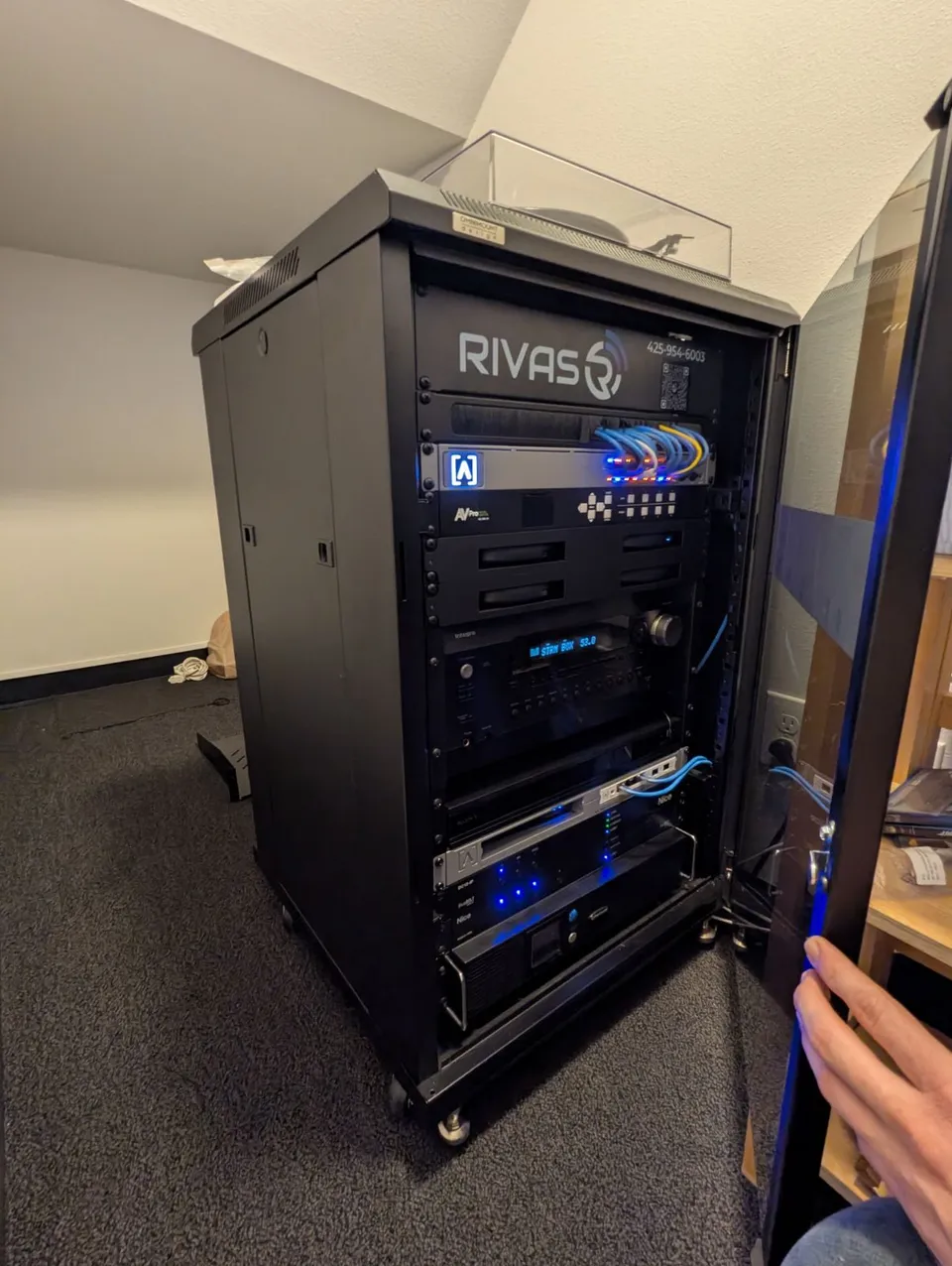


Rivas Technology Group installs professional networks for homes and businesses across south King and Pierce counties. A professional network is a router, wired access points, PoE switching and labeled cabling designed from a site survey. The price is fixed in a proposal before install day.
- Response
- Call or text back within one business day
- Price
- Fixed proposal before install day
- License
- WA electrical contractor RIVASGL799DR, bonded and insured
- Hardware
- Island Router, Ruckus, Alta Labs, Ubiquiti UniFi
- Reviews
- 5.0 from 49 Google reviews
What does a proper network include?
Seven parts, designed together. A site survey and RF plan, a router with a real firewall, wired access points, and Cat6A or fiber cabling. Then PoE switching, battery backup, and VLAN and priority rules for the systems that ride on it.
- Site survey and RF plan. We walk the property with a meter before any hardware is ordered. Access points go where the signal needs them, not where the outlet happens to be.
- Routing. An Island Router at the core for most homes. UniFi or Alta Labs routing where the project calls for it.
- Wired access points. Ruckus, Alta Labs or Ubiquiti UniFi, each fed by its own Ethernet run. No wireless hops, so no speed loss between floors. Outdoors, directional Ruckus units cover acreage, as on the Sequim outdoor Wi-Fi project.
- Structured cabling. Cat6A, and fiber where a run is long or a future upgrade is likely. Every cable labeled at both ends.
- PoE switching and a rack. One switch powers the access points and cameras. A patch panel and a small UPS keep it serviceable and up through a short outage.
- VLANs and priority. Cameras, automation, guests and streaming on separate networks. The traffic that matters is put first.
- Documentation. A map of what is where, so the next person to open the rack understands it.
Island Router: the core we start from
For most homes we start from an Island Router, a wired router built in the United States with no subscription and no cloud account. The firewall and routing do not depend on a service that can be discontinued or a fee that can rise1. It has no Wi-Fi of its own; that is what the wired access points are for2.
Two models, Island and Island Pro, cover everything from a 2,000-square-foot house to an estate with a camera system. Specs, who each fits and the FCC context are on the Island Router page. Our field notes from Tacoma-area installs are in the Island Router review.
Business networks
For an office, restaurant, shop or clinic we build the same way with different rules. Guest Wi-Fi walled off from point of sale, cameras on their own network, and a rack that an IT contractor can read. CURATOR remote monitoring sits behind it. Two examples: the network and phone rebuild at Washington Pottery Company, and the routing and Wi-Fi rebuild at South Sound Law Group. There, client data now sits on a segmented, documented network. Cabling, rack builds and PoE for larger sites are on the commercial infrastructure page; the full commercial offer is under Commercial.
What drives the cost
Four things set the price: the number of cable drops, the number of access points, and whether you need a rack and switch. The fourth is how far the runs have to travel through finished walls.
- Cable drops. Each run from the rack to a jack is labor plus a Cat6A termination at both ends. A drop through an unfinished basement costs less than one fished through a 1990s two-story.
- Access points. One per floor is the floor, not the ceiling. Outbuildings, patios and shops each add one, and outdoor units cost more than indoor ones.
- Rack, switch and backup. A home with cameras and automation needs a PoE switch, patch panel and UPS. A small house with three access points may not.
- Router model. Island or Island Pro. Chosen by internet speed and device count, not by house size alone.
- Existing conditions. Reusable conduit or a clean attic lowers the labor; stucco, masonry and finished ceilings raise it.
For scale, a Seattle cabling contractor advertises a basic drop at $150 installed with a jack and faceplate, as of September 20263, and Angi's national range runs $100 to $400 a room4. Treat those as the floor. A licensed custom integrator in the Puget Sound prices at the top of that range or above it. Every run we pull is tested, labeled and terminated in a rack, with the drawing to match, on a crew billed at the rates on the pricing page. Your number comes from the instant quote in a few minutes, and from the site survey as a fixed proposal.
How the process works
Four steps, and the price is locked before the first cable is pulled.
- Walk-through and survey. We meet at the property, look at every floor and outbuilding, and measure signal where it drops out. No charge within 20 miles of Kent.
- Design and fixed proposal. Within three to five business days you get a written scope: access point locations, drop count, rack contents and one price. That price does not move unless you change the scope.
- Install day. Our own team runs the cable, builds the rack, mounts the access points and configures routing, VLANs and priority. Everything labeled.
- Test and handoff. We walk the property again with the meter, hand you the network map and passwords, and stay reachable. Installation workmanship is warranted for 90 days (pricing and policies); CURATOR adds monitoring after that.
The FCC router rule, stated correctly
In March 2026 the FCC added foreign-produced consumer-grade routers to its Covered List, which stops new foreign-made consumer router models from being authorized for sale in the US5. Routers already in homes stay legal. The waiver that lets them keep receiving software updates was first set to expire March 1, 2027, and the FCC has extended it to at least January 1, 20296.
So: you do not have to replace a working router today, and March 2027 is not a cutoff. If you are buying new, buy one that will still be sold and supported in 2029. The Island Router is built in the United States1, which is one reason it is the router we start from.
Where we work
We install networks in Kent, Renton, Tukwila, Federal Way, Auburn, Covington, Maple Valley, Tacoma, Puyallup, Sumner, Bonney Lake, Tehaleh, University Place and Gig Harbor. Our office is at 415 Railroad Ave S in Kent. Olympic Peninsula by appointment. City pages: Kent, Renton, Tukwila, Federal Way, Auburn, Covington and Maple Valley, Tacoma, Puyallup, Sumner, Bonney Lake, Tehaleh, University Place, Gig Harbor.
The network is where our security and smart home work starts, and it is the first thing we check on a service call.
Questions we hear
How much does a home network installation cost?
It depends on the number of cable drops, access points and whether you need a rack. We do not publish a flat price because no two houses wire the same way. The instant quote gives you a number in a few minutes; the site survey turns it into a fixed proposal.
Do I need wired access points or will mesh do?
Wired access points if the house has more than one floor, thick walls, a shop or a patio you want covered. Each wireless mesh hop loses speed; an Ethernet-fed access point does not. Mesh works in a small single-level home with few devices.
Can you fix dead zones without rewiring the house?
Usually. Most dead-zone fixes are one or two wired access points reached through the attic, crawl space or existing conduit. The site survey tells us which, and whether a full structured-wiring job is the better long-term answer.
What is the Island Router and why do you install it?
A wired router built in the United States with no subscription and no cloud dependency, from PerfTech. It handles routing and the firewall; separate access points handle Wi-Fi. Specs, models and the FCC context are on our Island Router page.
Do I have to replace my router because of the FCC rule?
No. The FCC stopped authorizing new foreign-made consumer router models in March 2026, but routers already installed stay legal. They keep receiving updates under a waiver now extended to at least January 1, 2029. If you are buying new, buy a router that will still be supported.
Do you do business networks?
Yes. Offices, restaurants, shops and clinics in south King and Pierce counties. We provide structured cabling, PoE switching, business Wi-Fi, VLANs that separate guests, cameras and point of sale, and remote monitoring through CURATOR.
Will the network work with my Control4 system and Ajax cameras?
Yes. We put automation, cameras and audio on their own VLANs and set traffic priority so a camera upload never stalls the movie. When one team designs the network and the systems on it, they do not fight.
Where do you install networks?
Kent, Renton, Tukwila, Federal Way, Auburn, Covington, Maple Valley, Tacoma, Puyallup, Sumner, Bonney Lake, Tehaleh, University Place and Gig Harbor. Olympic Peninsula by appointment.


Start with a site survey.
Tell us about the property and what drops out. We walk it with a signal meter, then send a fixed proposal you can read on your phone. We call or text back within one business day.