Business security
How do you secure a site that has no power and no internet?
Every security product assumes two things a job site does not have for the first several months: an outlet and a network. That is why site security so often ends up as a padlock and hope. Here is what off-grid security actually needs, what changes in a Puget Sound winter, and how to tell a real solution from a generator with a camera on it.
A site with no power and no internet needs security that brings both: its own solar panel and battery for power, and its own cellular connection for reporting. The practical constraint is winter. Washington delivers about 6.37 peak sun hours a day in July and 1.32 in December, so an off-grid device collects roughly a fifth of its summer energy while its load stays the same. Low-draw devices such as intrusion detectors and a hub ride that out on a small panel. Cameras and recorders usually need a much larger array, shore power or a generator.
By Ivan Rivas, Owner and Sales Engineer · 2026-09-23 · Updated 2026-09-23

The problem is not security, it is infrastructure
Every product on the market assumes an outlet and a network. Wire a camera, plug in a recorder, join the Wi-Fi. A construction site has none of that for the first several months, and what it does have moves with the phases. The temporary power that reaches the trailer in month two is nowhere near the laydown yard in month six.
So site security defaults to a padlock, a light on a timer and somebody driving past on Sunday. Meanwhile the ground is holding six figures of material and sitting empty for sixty-one hours every weekend.
What off-grid actually has to solve
Three things, and most vendors only talk about the first.
Power. A panel and a battery sized for the load, not for the brochure. The number that matters is not the panel wattage, it is whether generation beats draw in the worst month.
Connection. Its own cellular, with its own SIM. Not the site Wi-Fi, not a hotspot belonging to somebody who takes it home at 4 p.m.
Mounting. Something rigid to put it on. This sounds trivial until you are on a site with no fence and no building, at which point the answer is a self-contained unit that stands on its own base, or a driven post.
The winter arithmetic
This is the part to ask about, because it is where off-grid systems quietly fail in their first December.
Washington delivers about 6.37 peak sun hours a day in July and 1.32 in December1. That is roughly a fifth of the energy, and the load does not shrink to match. Whether a system survives that comes down to how much it draws.
A handful of intrusion detectors, a hub and a couple of sirens draw very little. They sit idle most of the time and wake on an event, so a modest panel and a decent battery carry them through a grey month without help.
Cameras are a different animal. They run continuously, they push video, and a recorder runs alongside them. That is why solar camera trailers arrive with a generator, a much larger array, or a note in the contract about shore power. None of that is dishonest, it is just physics, and it is worth knowing before you sign a lease that runs October to March.
The question to ask any vendor: in December, on this site, what is your generation against your draw? If the answer is a shrug or a brochure figure from July, keep asking.
What we put on ground with nothing on it
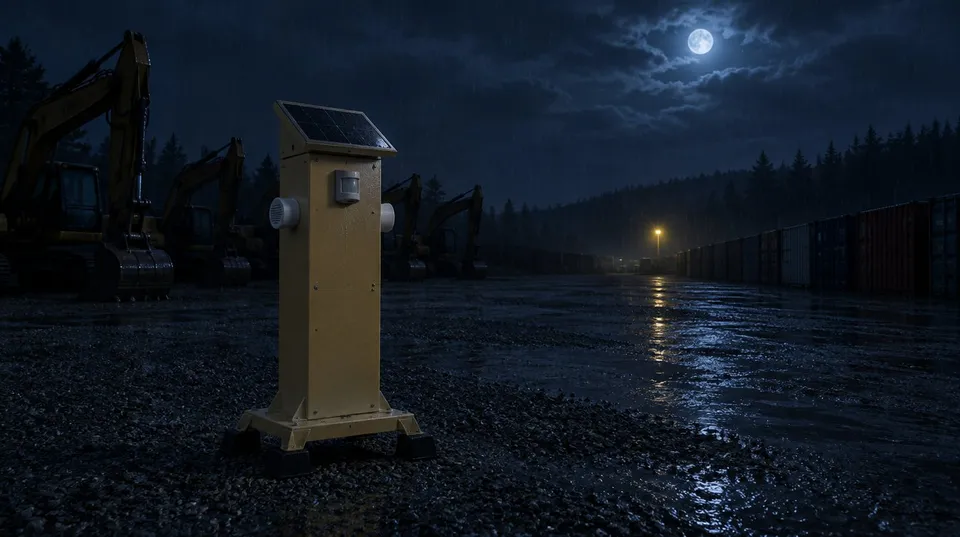
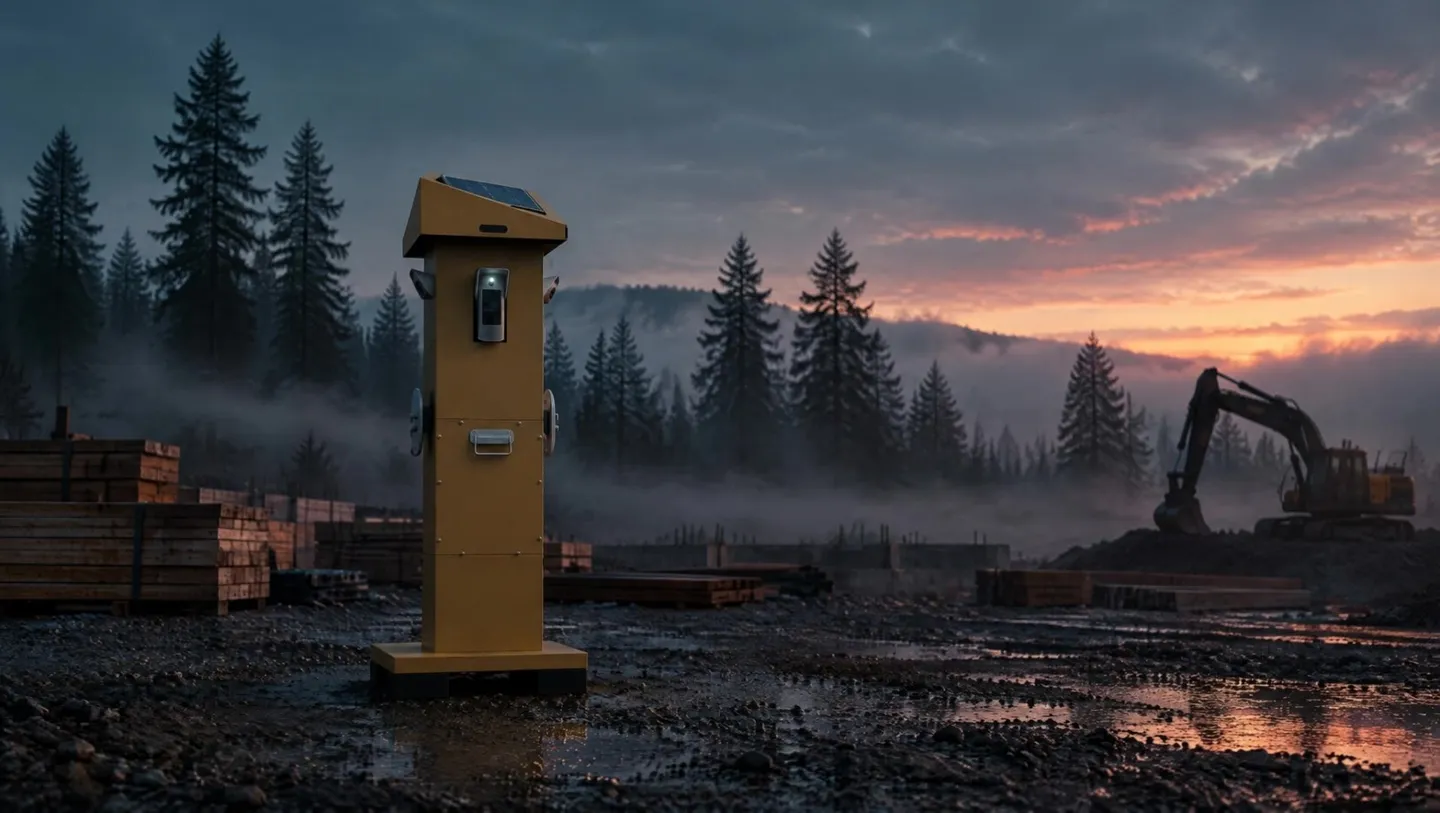
A solar alarm tower. It carries its own 25 W panel, an 80 Ah battery and an Ajax Hub 2 on cellular, and it stands on a raised base rather than needing a wall. Four outdoor detectors cover the sides, two sirens sound where the intruder is, and every alarm arrives with a photo of what triggered it.
Because the hub is wireless, the coverage is not limited to the tower. Detectors can go on fence posts, poles and container walls elsewhere on the site, within radio range of the hub, and a range extender bridges the far corners. So one unit can cover a yard, and it can also cover the gate, the container row and the materials cage.
Not on trees, though. Ajax advises against it and the reason is practical: wind moves a tree, a moving detector re-aims itself, and what it covered at noon is not what it covers at midnight.
What it does not solve
It does not record video, so if you need footage for a claim you need a camera system as well or instead. And it does not put a person on your site: the sirens sound and your phones ring, and unless you add monitoring, nobody reviews the photo but you.
Both of those are fine as long as you know them going in. The comparison is on alarm or cameras for a job site, and the whole approach is on construction site security.
Where we work
From 415 Railroad Ave S, Kent, WA 98032: Kent, Renton, Tukwila, Federal Way, Auburn, Covington, Maple Valley, Tacoma, Puyallup, Sumner, Bonney Lake, Tehaleh, University Place and Gig Harbor.