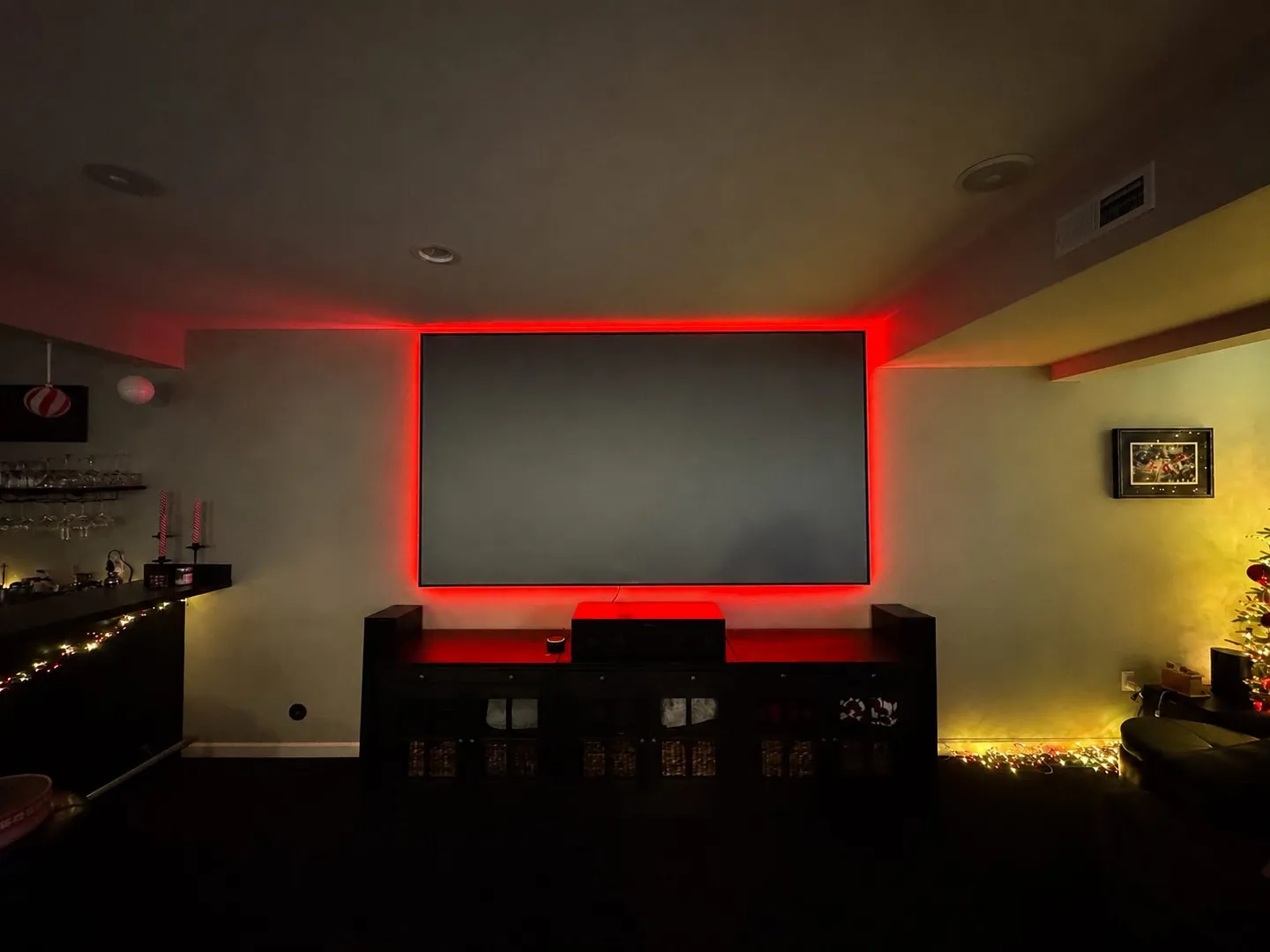
Theater and audio
Why do Phase Technology's flat-piston speakers outperform cones?
A flat, rigid piston driver moves as one surface, so it does not flex or leak internal reflections the way a cone can. Phase Technology pairs it with crossovers and mounts built for in-wall use. Here is what that means in a home theater or whole-home system in the South Sound.
A flat, rigid piston driver moves as one surface, so it does not flex or pass internal reflections back through the diaphragm the way a cone can. Phase Technology pairs it with Absolute Phase crossovers and clamping mounts built for in-wall use. Rivas Technology Group uses them in South Sound theaters and whole-home systems.
By Ivan Rivas, Owner and Sales Engineer · 2025-10-09 · Updated 2026-09-17

What is Phase Technology's flat-piston technology?
A driver whose diaphragm is a rigid flat plate rather than a cone, moving as a single piston. Phase Technology builds many of its drivers from what it calls RPF, rigid polymer foam. The surface is acoustically opaque: sound generated behind the driver does not pass back through it, so internal reflections and the comb filtering they cause are reduced.
Around that driver the company adds three things that matter for a home install. Absolute Phase crossovers keep the drivers in phase with each other acoustically and electrically. Unicell treatment reduces diffraction from cabinet edges. Positive clamping mounts hold an in-wall speaker rigid in the drywall. Clients in Tacoma and Gig Harbor ask Rivas Technology Group why we recommend them over conventional cones; this post is the answer.
What do cone drivers do well, and where do they fall short?
Cones are proven, economical and effective, especially in bass and midbass, and most of the speakers in the world use them for good reason. Their limits show up in demanding installs. A cone can allow resonances and rear reflections to leak through or bounce inside the driver, which colors the sound. At higher frequencies a cone can stop moving as one piece and ripple, which reduces clarity.
In-wall and in-ceiling installations add edge diffraction, coupling to the wall cavity and mounting problems that a box speaker on a stand never has. And keeping woofer, midrange and tweeter coherent through the crossover is harder. In a home theater or a high-fidelity listening room, those differences are audible in midrange clarity, imaging and distortion.
Why does the flat piston deliver better results?
Five reasons, each tied to something you hear.
- Lower internal distortion. The opaque driver surface keeps rear reflections from interfering with the forward wave. The sound is cleaner as a result.
- Phase coherence. Absolute Phase crossovers keep the drivers acoustically and electrically in phase. That gives tighter imaging and a smoother blend between drivers.
- Consistent mounting. The positive clamping system holds the speaker rigid in a wall or ceiling. That reduces resonance from the drywall around it.
- Uniform dispersion. A flat piston radiates more evenly across its surface, so off-axis seats do not lose the top end the way they can with a cone. That matters in a distributed audio zone where nobody sits in the sweet spot.
- Flush-mount performance. In-wall and in-ceiling channels keep their performance when mounted flush. That is what a theater built into the architecture needs.
Listeners and reviewers consistently describe the result as smooth highs, a transparent midrange and precise imaging; in our installs, dialogue at low volume is the test, and these pass it.
Why does Rivas Technology Group recommend them?
Because we pick gear for how it performs in real rooms, with real walls, HVAC noise and reflections, and Phase Technology holds up there. In-wall and in-ceiling mounting resilience makes them right for clean, hidden installs in homes across Tacoma, Gig Harbor, Bonney Lake, University Place and Puyallup.
They integrate with home theater, distributed audio and the Control4 system that runs the rest of the house. The engineering has a long track record, and parts and support are there when a speaker needs service years later. We are also a Cambridge Audio authorized retailer, so a Phase Technology speaker set is proposed with amplification chosen to match.
Where do we use them?
In theaters and whole-home zones where the speaker has to disappear. A dedicated theater in Gig Harbor gets flat-piston in-wall left, center and right channels behind the screen wall, surrounds in the side walls and in-ceiling height channels. The coherence across those channels is what makes dialogue, a score and an effect pan feel like one space.
A main floor in Tacoma with four audio zones gets in-ceiling models whose even dispersion covers the kitchen and dining room without a hot spot under each speaker. Because our team handles the network, the automation and the install, the speakers are one part of a designed system rather than an upgrade bolted on. Options are on the home theater and audio page.
What drives the cost?
Channel count, the speaker model per position, amplification and how much cable has to travel through finished walls. A 5.1 in-wall theater is one job; a theater with height channels plus six whole-home zones is another. The instant quote gives you a figure in minutes and a walk-through turns it into a fixed proposal.
Need it installed?
Rivas Technology Group designs and installs home theater and whole-home audio from Kent across south King County and Pierce County, including Tacoma and Gig Harbor. Book a walk-through and we will design the speaker layout for your room.