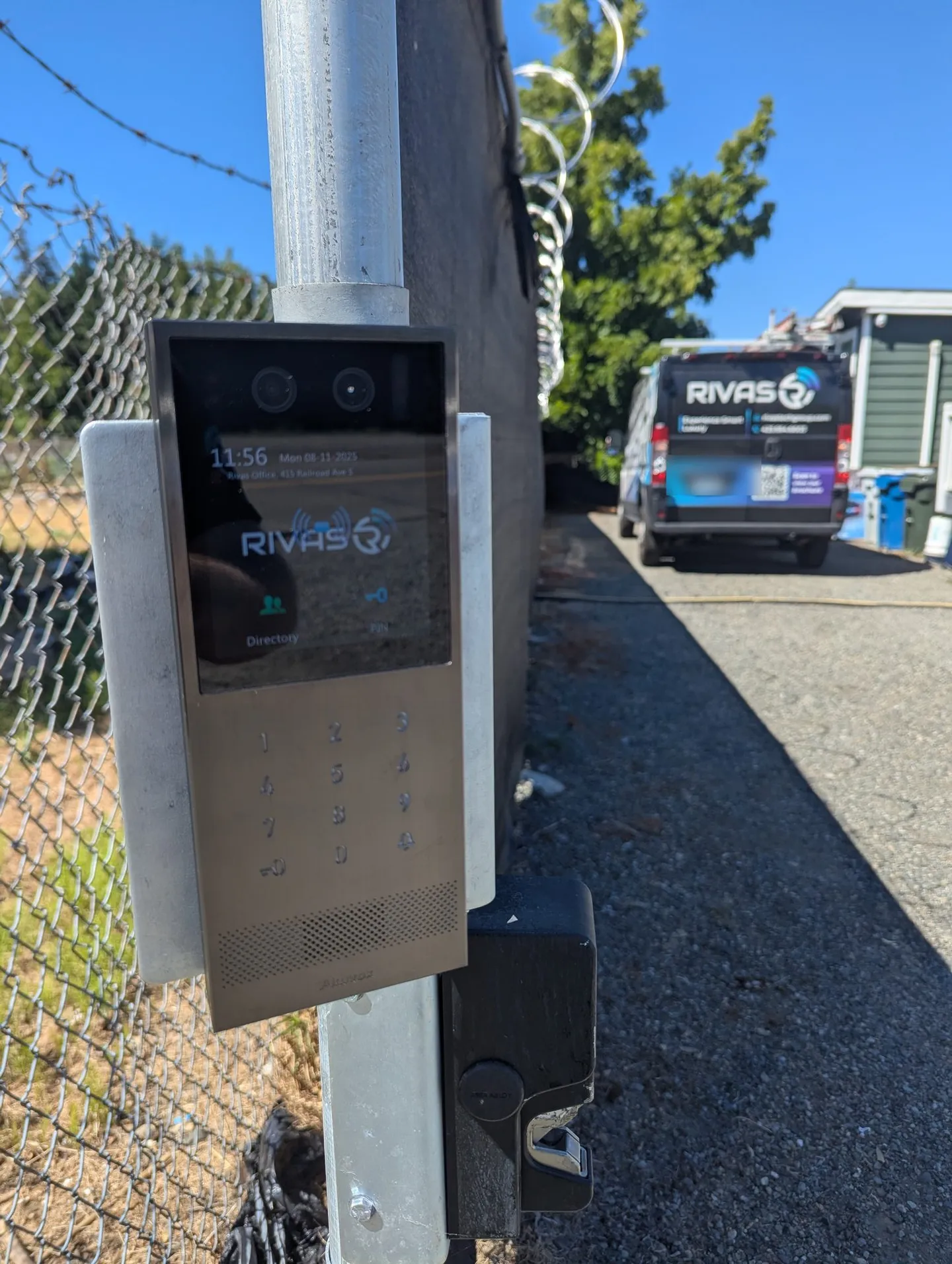
Business security
Door access control for a small business: keys, cards or phones.
Most small businesses still run on keys, and many that moved to cards are on a type that can be copied. Here is what a door access control system does, which credentials hold up, and what to ask before you buy one.
A door access control system puts a reader, a controller and an electric lock on each door, so staff open it with a card, phone or PIN you can revoke. For a small business, choose encrypted 13.56 MHz cards or phones over 125 kHz prox cards, which HID says are easily cloned.
By Ivan Rivas, Owner and Sales Engineer · 2026-11-04 · Updated 2026-11-04

What a door access control system does
A door access control system decides who may open which door, and when, and keeps a record of every opening. It replaces keys with credentials you hand out and take back from a screen.
Each controlled door has four parts. A reader takes the credential. A controller checks it against the person's schedule. An electric lock releases the door. A door position sensor reports whether the door actually opened, or was propped. The access control installation page covers the hardware door by door.
Why keys stop working for a business
Keys have three problems that get worse as a business grows. They do not expire. They do not keep a record. And you cannot take one back from someone who has already copied it.
So when an employee leaves, the choice is to trust them or rekey. When stock goes missing overnight, nothing says whose key opened the back door. Unwanted entry is a live problem here: in mid-October the Kent Police blotter listed a commercial burglary at a closed business on 80th Avenue South with "multiple prior incidents involving unauthorized entry"1.
Prox cards: the upgrade that can be copied
Many businesses that left keys behind moved to 125 kHz proximity cards, the plain white cards and fobs on so many key rings. They are cheap and they work. They are also the weak spot.
HID, a card maker, says "125 kHz prox cards are easily susceptible to spoofing and cloning"2. A copied card opens the door exactly like the real one, and the log records the real cardholder's name.
The fix HID points to is an encrypted credential, and new systems use encrypted 13.56 MHz cards and fobs. UniFi Access, one of the two platforms we install, uses a per-site token to generate unique encryption keys for its cards and fobs3.
Leave the old cards switched off
An upgrade only closes the gap if the old format stops working. HID warns that readers "that remain enabled to read legacy credentials after the completion of the migration increase risk as well." If the new reader still accepts old prox cards, a copied prox card still opens the door.
UniFi Access readers settle it by design: they read 13.56 MHz only, and cards on other frequencies are not recognized3. On other platforms, ask for the legacy format to be switched off once the last old card is replaced.
The wire between the reader and the controller matters too. HID notes that the older Wiegand protocol "presents risks with reader-to-controller communication" and calls OSDP, with AES-128 encryption and wire monitoring, "a far safer option." Ask any bidder which one their readers use.
Cards, phones or PINs?
Most small businesses end up with a mix, and each credential has a job.
- Phones suit most staff. On UniFi Access, a badge can live in Apple Wallet or Google Wallet, which Ubiquiti calls Touch Pass4. People rarely forget their phone, and they rarely lend it.
- Encrypted cards and fobs suit staff who prefer one, shared roles and anyone without a smartphone.
- PINs suit vendors and cleaning crews on a schedule: a code that works on Tuesday and Friday evenings and nowhere else.
- Face, QR and visitor codes belong at a front entry with an Akuvox video intercom, where couriers and visitors need a time-limited way in. We are an Akuvox certified installer; the models are on the intercom and access control page.
For an interior door that does not need a wired reader, such as a private office or a supply room, we recommend the Alfred ML2 mortise lock. It stores up to 250 PIN codes and 250 RFID cards and opens from a phone over Bluetooth5.
Which doors to do first
Start where losses and questions start. That is usually the back door, the office, the stockroom and the server or records room, not the front door customers use all day.
In a Kent Valley warehouse it is often the staff entry and the dock door, on schedules that follow the shifts. In a clinic it is medication and records. Two or three well-chosen doors answer most of the "who was in there?" questions a manager asks.
Exits and power cuts
People must always be able to get out. The 2021 Washington State Building Code says egress doors "shall be readily openable from the egress side without the use of a key or special knowledge or effort"6.
So the hardware on an exit path is chosen to keep that true, with a handle or a request-to-exit sensor on the inside. What each lock does when the power drops is set door by door: a maglock releases, and an electric strike usually stays locked while its inside handle still opens it. Doors on a fire-rated or required exit path are confirmed with the building or fire official before we install them.
With the alarm and cameras
Access control, the alarm and the cameras are layers, not rivals. The access system decides who may open a door. The alarm decides that something is wrong after hours. The cameras show what happened.
A door contact on a controlled door can report to an Ajax alarm, so a door forced open at night is an alarm rather than a line in a log. A reader or intercom camera at the entry puts a face next to the card.
What to ask before you buy
- Which card format, and is it encrypted? Avoid new 125 kHz prox cards.
- Will the old format be switched off? Ask what happens to legacy cards after the change.
- Wiegand or OSDP between reader and controller?
- What does it cost each month, per door, over five years? Some platforms charge nothing for software; many cloud brands charge per door.
- What does each lock do when power fails, and how do people get out?
Where we work
Rivas Technology Group installs door access control from 415 Railroad Ave S, Kent, for businesses in Kent, Tukwila, Renton, Auburn, Federal Way, Covington, Maple Valley, Tacoma, Puyallup, Sumner and Gig Harbor. The access control installation page explains the walk-through, and the instant quote gives a first figure in minutes.